|
SKATES & RAYS
|
COMMON SMOOTHHOUND SHARK Mustelus mustelus
COMMON NAMES: Common Smoothhound, Grey Mouth Dog, Common Houndshark, Smooth Dogfish, Sweet William, Emissole Lisse (Fr), Musola (Es)
SYNONYMS: Squalus mustelus (Linnaeus, 1758), Mustelus laevis (Linck, 1790), Mustelus vulgaris (Cloquet, 1821), Mustelus levis (Risso, 1826), Mustelus equestris (Bonaparte, 1834).
APPEARANCE: Dorsal fin is large and prominent, the first larger than the second. First dorsal fin originates over pectoral free tips. No dorsal spines. Large pectoral fins. Anal fin present. Large dorsal caudal lobe with large subterminal notch and lobe. Grey or grey-brown dorsally. Ventrally light. The Common Smoothhound is a slender species with two large prominent dorsal fins, the first larger than the second. The first dorsal fin originates over the base of the pectoral fins, the second just forward of the anal fin. There are no dorsal spines and the free rear tips are small. The dorsal caudal lobe is large with a strong terminal notch and lobe. It can be an easily identifiable species as it is the only member of the Mustelus genus without white or black spots in European waters. However, on the Starry Smoothhound, Mustelus asterias, these spots can be faded or completely absent meaning that any Mustelus spp with no white spots cannot automatically be attributed to the Common Smoothhound (Farrell et al. 2009). Positive identification can be made physically in 3 ways. Firstly, buccopharyngeal denticles cover the entire palate and floor of the mouth in the Starry Smoothhound but only the tongue tip and extreme anterior end of the palate in the Common Smoothhound. Secondly, the longitudinal ridges of the dermal denticles extend only half way along their length in the Starry Smoothhound, whereas in the Common Smoothhound they extend along their entire length (Compagno,1984). Lastly, the connection between the female and the embryo is different between the species. None of these methods are particularly useful for live specimens or large numbers of sharks. The last in particular only works for gravid females landed whole. Genetic identification methods are therefore becoming more widespread (Farrell et al , 2009). Amongst similar species from different genus, it can be distinguished from the Tope Shark, Galeorhinus galeus, by the lage second dorsal fin (larger than the anal fin) and from the Spiny Dogfish, Squalus acanthias, by the presence of an anal fin and absence of dorsal spines (Compagno, 1984).
DISTRIBUTION:
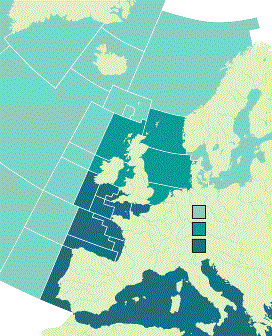
The range of the Common Smoothhound was until very recently believed to cover the northeast Atlantic from the British Isles to Madeira and the Canary Isles, including the Mediterranean Sea. (Compagno, 1984). Genetic studies are beginning to show that confusion with the Starry Smoothhound. Mustelus asterias could have lead toan overestimate of its range (Farrell et al, 2009). It is also known from South Africa (Compagno,1984). Text & Illustrations © Shark Trust 2009
SIMILAR SPECIES ARE: From top to bottom Mustelus mustelus,Common Smoothhound Mustelus asterias, Starry Smoothhound Mustelus punctulatus, Blackspotted Smoothhound Galeorhinus galeus, Tope Shark Spualus acanthias, Spiny Dogfish
Not to scale
TEETH The teeth are asymmetric with the cusps reduced to a low point. Very young individuals may have cusplets Cpmpagno, 1984). The tongue tip and extreme anterior palate are covered in buccopharyngeal denticles (Farrell et el., 2009)
ECOLOGY AND BIOLOGY
HABITAT The Common Smoothhound can be found to at least 350m on continental shelves and the uppermost slopes. It is most usually found on or near the bottom from 5-50m but can be found swimming mid-water (Compagno, 1984). It is predominantly an inshore species found around tidal flats, estuary mouths and in shallow bays with sandy, muddy or gravel substrate. It has been recorded offshore, often ossociated with sand banks and other topographical features (Fakhoury and Fergusson, Uknown). DIET The most important prey items for the Common Smoothhound are benthic crustaceans including hermit and other crabs, lobster and shrimp. It also feeds on cephalopods and small bony fish (Fakhoury and Fergusson, Uknown). An individual caught at 300m had a mid-water fish (Chlorophthalmus spp.) in its stomach (Compagno, 1984)
REPRODUCTION Male Common Smoothhound mature around 70-74cm in length, females around 80cm. It is a viviparous species with a yolk sac placenta. After a gestation period of 10 to 11 months it gives birth to 4-15 young, each measuring around 39cm in length (Compagno, 1984).
EGGCASE N/A
COMMERCIAL IMPORTANCE Smoothhound sharks are of little interest to fisheries in northern Europe. They are targeted throughout the Mediterranean however as their flesh is appreciated in southern Europe (Farrell et el., 2009). The Common Smoothhound is taken as bycatch in mixed species trawls, longline fisheries and occasional by pelagic fishers using trawls and driftnets. If landed in northern Europe, the flesh can be utilised fresh and frozen for human consumption (mainly in France and Germany), the liver can be processed for its oil and the carcass can be used for fishmeal (Compagno, 1984).
|
Sue Daly
|
|
IMPORTANT NOTICE This web-site is protected under international copyright laws and is the property of Carol Medder. Any unauthorised copying or transmission of its contents in full or in part is prohibited without prior permission of the author. Schools, colleges and universities are allowed to use the contents for educational purposes. C.Medder1991/2014© |